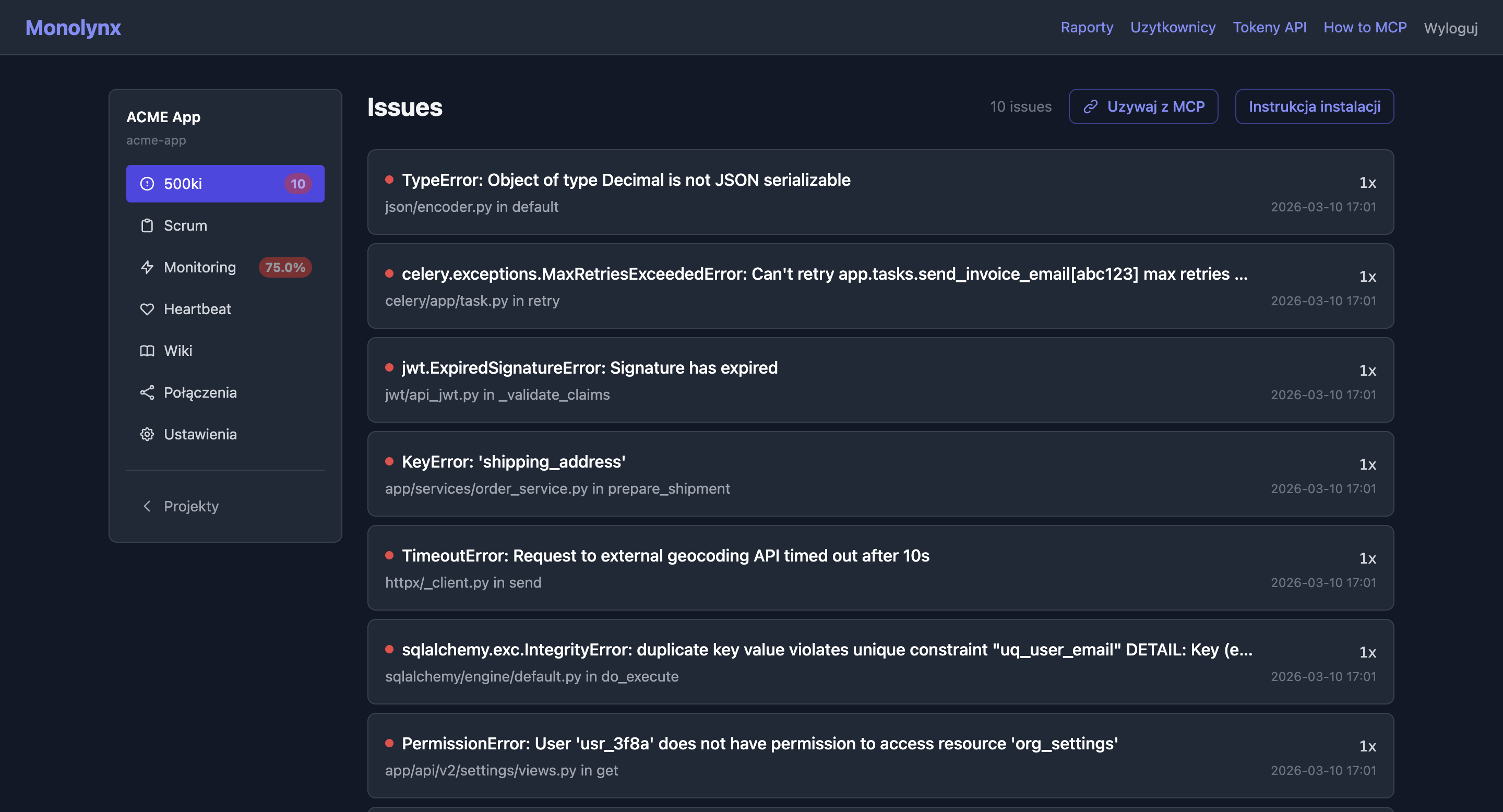
500s automatically groups exceptions from your applications using smart fingerprinting. The lightweight Django SDK captures errors in the background — zero performance impact.
SHA256 algorithm combines exception type with app-frame filenames and functions. Line number changes don't create new groups — the fingerprint is stable.
Stacktrace, request data (URL, method, headers), environment variables — all stored in PostgreSQL JSONB.
Denormalized event_count on each issue. See which errors occur most often — no expensive COUNT queries.
One click to create a backlog ticket with auto-filled description: stacktrace, request URL, and environment.
Every public SDK function is wrapped in try/except. Background sending via ThreadPoolExecutor — zero impact on response time.
Mark errors as resolved. Filter the list to focus on active problems.
pip install monolynx-sdk and add middleware to Django settings.py. Configuration is 3 lines.
Middleware catches every unhandled exception and sends it in the background to the Monolynx API.
System computes a fingerprint (SHA256) and assigns the event to an existing issue or creates a new one.
Issue list sorted by last occurrence. Click to see full stacktrace and context.
Mark the issue as resolved or create a Scrum ticket for sprint work.
Your AI agent can browse errors, analyze stacktraces, manually report bugs, and create tickets from them — 5 MCP tools.
Available MCP tools
list_issues
List errors with status filtering and text search
get_issue
Full details: stacktrace, request data, event history
update_issue_status
Mark error as resolved or reopen
create_ticket_from_issue
Create a Scrum ticket with auto-filled error description
create_issue
Manually report a bug without generating a real exception
Agile project management
URL health checks
Cron job monitoring
Documentation & RAG search
Dependency graph
Work analytics & PDF export
Cross-project billing & attachments
Personal cross-project scheduling
AI agent work observability
Work from the terminal
Public blog readable by people and AI